
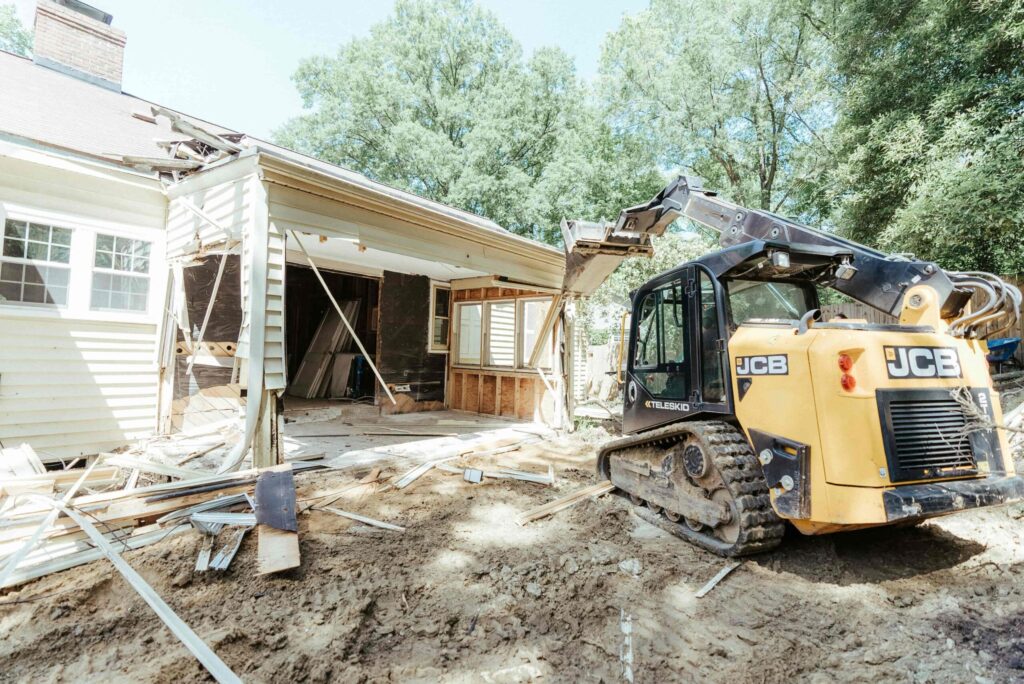
What Concrete Demolition Actually Involves
When most homeowners picture concrete removal, they imagine a crew showing up with a sledgehammer and hauling chunks away in a pickup truck. The reality is a bit more involved — and understanding the process helps you plan realistically for cost, timeline, and access on your property.
Concrete demolition typically involves three stages: breaking the slab or structure into manageable pieces, loading those pieces, and hauling the debris to a recycling facility or approved disposal site. Each stage has its own equipment demands and site requirements, which is why access to your property matters as much as the concrete itself.
Breaking the Slab: Tools and Methods
The thickness and reinforcement of your existing concrete determines which breaking method a contractor will use.
- Electric demolition hammers and jackhammers are the standard for most residential work — driveways, patios, sidewalks, and pool decks that are 4 to 6 inches thick.
- Hydraulic breakers mounted on mini-excavators speed up larger jobs like full driveway replacements or thicker slabs, and they reduce labor fatigue on big pours.
- Saw cutting is used when a contractor needs clean, straight cuts — for example, removing only a damaged section of a concrete driveway while leaving the rest intact.
- Wire mesh and rebar removal adds time and cost. Most Florida residential slabs contain some form of steel reinforcement, and that steel has to be separated from the broken concrete before hauling.
In South Florida’s heat, experienced crews work efficiently in the early morning hours and stage debris strategically so the haul truck can load without multiple repositioning trips.
Access: The Factor Most Homeowners Overlook
Good site access directly controls how fast — and how affordably — a demolition job gets done. Before a crew arrives, think through these questions:
- Can a skid-steer or mini-excavator reach the work area? A tight side yard or a fence with a narrow gate can mean everything must be broken by hand and wheelbarrowed to the truck — adding hours to the job.
- Where will the haul truck park? A concrete haul truck or roll-off dumpster needs a solid, flat surface. Soft soil or landscaping beds can be damaged by a loaded vehicle, so plan the staging area in advance.
- Are there underground utilities nearby? Florida law requires a Sunshine State One Call locate before any demolition near underground lines. A licensed contractor handles this as standard practice.
- Will neighboring properties or HOA rules limit work hours? Many communities in Palm Beach Gardens, Jupiter, and Wellington enforce noise ordinances that restrict heavy equipment to specific daytime windows.
If you have a gated community or a property with limited vehicle access, communicate that to your contractor during the estimate — it affects crew size and equipment choices from the start.
Concrete Disposal and Haul-Away in South Florida
Broken concrete — called rubble or clean fill — is a recyclable material. Most of it gets crushed and reused as road base or aggregate. That’s good news: legitimate disposal options exist, and responsible contractors use them.
What you want to avoid is a contractor who vaguely says they’ll take care of it without explaining where the material goes. In Florida, illegal dumping of construction debris carries real penalties, and as the property owner, you can be drawn into disputes about where your old slab ended up.
When you receive a quote for concrete removal, confirm that haul-away and disposal fees are included or itemized. On larger jobs — a full driveway plus a patio, for example — the weight of the concrete can add up fast, and disposal cost scales with volume.
DIY vs. Licensed Contractor: An Honest Assessment
Some homeowners want to save money by renting a jackhammer and breaking the concrete themselves, then renting a dumpster for disposal. That can work in limited situations, but here is an honest look at when it makes sense and when it does not.
When DIY Can Work
- Small, isolated sections of unreinforced concrete — a short walkway section or a small garden border slab
- You have experience operating demolition equipment or a strong crew of helpers
- Access is easy, the slab is thin, and you have time to work at a slower pace
When You Should Call a Licensed Contractor
- Full driveway demolition — the weight of the material alone typically requires commercial hauling equipment
- Pool deck removal — working around existing plumbing, pool shell, and bond beams requires precision cutting, not brute force
- Any slab with heavy rebar — steel-reinforced concrete resists hand tools and quickly exhausts untrained workers
- Permitted work — if demolition is a step toward a new permitted structure, a licensed contractor’s involvement may be required by your municipality
- Tight access situations — professional crews have the right compact equipment to work in confined spaces without damaging your landscaping or neighbors’ property
Florida’s building contractor licensing exists for good reason. Blakenstone Construction holds license CBC1268642, meaning the work is performed by a team accountable to state standards — not a handyman with a rented breaker.
What to Expect After the Concrete Is Gone
Once the slab is broken and hauled away, the job site typically needs grading. Removing a thick slab leaves a low spot in the grade, and that void needs to be filled and compacted before new concrete — or any other surface — goes down. Ask your contractor whether grading and base preparation are included in the scope, or whether that is a separate line item.
If you are replacing the removed concrete with a new patio or pool deck, having the same contractor handle demolition and replacement is often the most efficient approach. The crew is already mobilized, the access path is established, and you avoid a gap between subcontractors.
Ready to Talk About Your Project?
Blakenstone Construction serves homeowners throughout Stuart, Port St. Lucie, Jensen Beach, Palm City, Hobe Sound, Jupiter, Palm Beach Gardens, West Palm Beach, and the surrounding Treasure Coast and Palm Beach County communities.
Whether you have a cracked driveway in Boynton Beach, a deteriorated pool deck in Riviera Beach, or an old patio slab in Fort Pierce that is simply time to go, we can walk you through access requirements, disposal options, and next steps — no pressure, no guesswork.
Martin & St. Lucie County: Call (772) 222-7317
Palm Beach County: Call (561) 763-4650
Or send us a message online and we will follow up promptly.