
Why the Order of Operations Matters More Than You Think
It’s tempting to focus on the finished product — a smooth, clean driveway or a welcoming backyard patio. But what happens beneath the surface, and in what sequence, determines whether that new slab lasts five years or twenty-five. For homeowners in Palm Beach, Stuart, and Port St. Lucie, understanding the demo-grade-pour sequence helps you ask better questions, avoid costly surprises, and recognize quality work when you see it.
Blakenstone Construction serves homeowners throughout the Treasure Coast and Palm Beach County, including Stuart, Port St. Lucie, Jensen Beach, Palm City, Hobe Sound, Jupiter, Palm Beach Gardens, and West Palm Beach. This post walks you through what happens before the first bucket of fresh concrete is poured.
Step One: Assess What You Have Before You Demolish Anything
Not every old slab needs a full tearout. A contractor should walk the existing concrete with you and look for a few key things before scheduling a crew and an equipment drop.
- Depth and thickness: Residential driveways in South Florida are typically four inches thick. Thicker slabs — six inches or more — are common near garage aprons or areas that have been patched over time. Thickness affects how long demo takes and how much debris you’ll haul.
- Cracking pattern: Random shrinkage cracks are cosmetic. Heaving, corner lifts, or cracks that run in a grid suggest a subbase or drainage problem that must be corrected before the new pour — not covered over.
- Tree roots: In Florida’s climate, ficus, oak, and sea grape roots can travel surprisingly far under a driveway or patio. If roots are involved, your contractor may recommend consulting an arborist before demo begins so root management and slab work can be coordinated properly.
- Utility locations: Florida law requires a Sunshine State One Call locate before any ground disturbance. A responsible contractor handles this automatically, but it’s worth confirming before demo day.
Step Two: Concrete Demolition and Removal Done Right
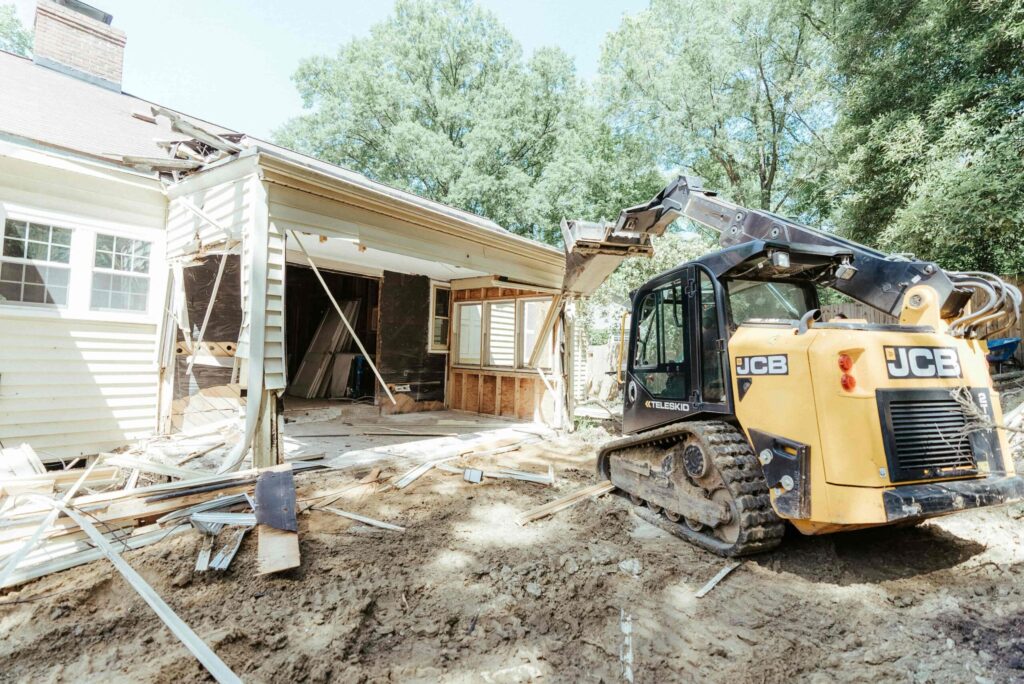
Once the assessment is complete, concrete demolition begins. For most residential patios and driveways, this means a combination of a jackhammer or electric breaker for smaller areas, and a skid steer or excavator with a hydraulic breaker for larger slabs. The concrete is broken into manageable sections, loaded, and hauled away.
What separates a careful demo from a sloppy one is edge control and site protection. Careless swings near a home’s foundation, a screen enclosure footer, or an adjacent sidewalk can create new damage that costs more to fix than the demo itself saved. Your contractor should use controlled breaking near any structure and protect existing landscape features during removal.
Proper concrete removal also means clearing all broken material — not burying chunks of old slab under new fill. Buried concrete creates voids as it shifts and settles, which leads to cracking in the new pour down the road.
Step Three: Subbase Preparation and Grading
This is the step homeowners rarely see, but it carries the most weight — literally. After the old slab is gone, the exposed subgrade needs to be evaluated and prepared before any new material goes down.
What Happens During Subbase Prep
- Soil compaction testing: Loose or disturbed soil must be compacted to a consistent density. In South Florida, sandy soils compact differently than areas with more clay content, and experienced contractors account for local soil conditions.
- Fill and grading: Low spots are filled and graded to direct water away from the structure. For a driveway, this usually means a slight crown toward the edges. For a patio or pool deck, the grade should pitch away from the home — typically one to two percent — so rainwater drains toward lawn or a catch area rather than pooling against the foundation.
- Base material: Depending on the application, a compacted base of crushed limestone or a road-base mix may be added before the concrete. This layer stabilizes the subgrade and prevents the kind of settlement that telegraphs into surface cracks within a few years.
Skipping or rushing subbase prep is the single most common reason a new concrete slab fails prematurely. No amount of thick concrete or quality mix design fully compensates for a poorly prepared subgrade.
Step Four: Forming, Reinforcement, and the Pour
With the subbase compacted and graded, the crew sets forms to establish the finished slab’s shape, elevation, and edge profile. For a new patio or pool deck, forms also define where control joints will be tooled or cut — the planned weak points that allow the slab to expand and contract with Florida’s heat without random cracking.
Reinforcement — typically rebar or wire mesh for residential applications — is positioned on chairs or supports so it sits in the middle of the slab depth, not resting on the subgrade where it offers little structural benefit.
Concrete is then poured, screeded level, floated, and finished to the specified surface texture. For driveways, a broom finish improves traction in the rain. For patios, a smoother or exposed-aggregate finish may be preferred. Curing begins immediately after finishing, and the slab should not be loaded for several days depending on mix design and ambient temperature.
Common Questions Homeowners Ask
Can you pour new concrete over old concrete?
In most residential driveway and patio situations, it is not recommended. Thin overlays bond poorly to existing slabs that are cracked or settled, and stacking concrete raises finished grades in ways that create drainage and threshold problems. Full removal and a fresh pour is the more reliable long-term solution.
How long does the whole process take?
For a typical residential driveway or patio, demo and removal usually take one day. Subbase prep takes another half day to full day. Forming and pouring is typically one day, followed by a curing period of three to seven days before normal use. Weather, project size, and permit requirements can affect the timeline.
Do I need a permit in Palm Beach or St. Lucie County?
Requirements vary by municipality and project scope. Driveways near the right-of-way and larger patio slabs often require a permit. Your contractor should identify permit requirements during the planning phase — it protects you as the homeowner and ensures inspections happen at the right stages.
Ready to Talk Through Your Project?
If you have an aging driveway, a cracked patio, or a slab that’s seen better days, the right starting point is an honest conversation about what’s underneath and what sequence makes sense for your specific property. Blakenstone Construction is a licensed Florida Building Contractor (CBC1268642) serving the Treasure Coast and Palm Beach County.
Homeowners in Stuart, Jensen Beach, Palm City, Hobe Sound, Port St. Lucie, and Fort Pierce can reach us at (772) 222-7317.
Homeowners in Palm Beach, West Palm Beach, Palm Beach Gardens, Jupiter, Boca Raton, Boynton Beach, Delray Beach, Lake Worth Beach, Riviera Beach, Wellington, Royal Palm Beach, and Tequesta can reach us at (561) 763-4650.
You can also send us a message online and we’ll follow up to learn more about your project.